Our final Day in France
The morning came way too early once again.
Joe was still coughing a lot but his bedroom was on the opposite side of the apartment from the rest of us so we never heard him.
But Bryan was having his own problems. His arthritic knees were getting worse from all the walking and he simply couldn’t handle another long day of it so he decided not to on the tour. Being our last day In Paris I rather liked the idea of a relaxing last day so I stayed behind with Bryan.
We slowly walked along the Seine River, visited the grounds of the Eiffel Tower and figured out the subway system.
The other four got up early and left for their meeting point at the Catacombs, a network of tunnels beneath Paris housing the remains of over six million people. The Catacombs unfortunately were not a part of the tour.
Since I was not there, Larry recorded the days adventure…
A Trip to the Loire Valley - by Larry
Our last full day in France found four of us (Joe, Alan, John, and Larry) traveling by bus to the Loire Valley, about three hours southwest of Paris, to visit two famous 16th Century French chateaus, taking a lunch break between the two in the nearby town of Blois (pop. 50,000).
Our comfortable motor coach left early from the famed Paris catacombs and was quickly engulfed in traffic and fog—so much for seeing the French countryside! After allowing over an hour for sleep to our group of about 20, our young Indian tour guide, Ratri (pronounced RA-tree), introduced us to the history of the Loire Valley.
And what a long and varied history this part of France has had! Not discounting the artifacts from the Stone Age that have been discovered here, the written records indicate many people groups inhabited this region over the centuries, beginning with various Gaelic/Celtic tribes; to the Romans who built roads, planted vineyards, and produced cheese; to the Germanic Franks who brought Christianity to the area and tried to unite everyone; to the Saracens, famous for their goat cheese; to the Vikings or “North Men,” one of whom became the King of Normandy; and finally to the English, who vied for control of the area from the French in the “Hundred Years War.” It was in this last period that the French nobility emerged that produced the beautiful country chateaux we were about to see.
Why did they build such lavish dwellings this far away from the cultural and political center of Paris? Well, it has to do with the river running through the valley, the River Loire. Whereas the River Seine winding through the heart of Paris is deep and wide, allowing foreign fighting ships easy access to its shores, the River Loire is quite shallow, giving the entire valley an automatic defense against invading forces. Thus, various kings and nobles keen on staying alive spent huge sums to show off their wealth and prestige away from the dangers of the city.
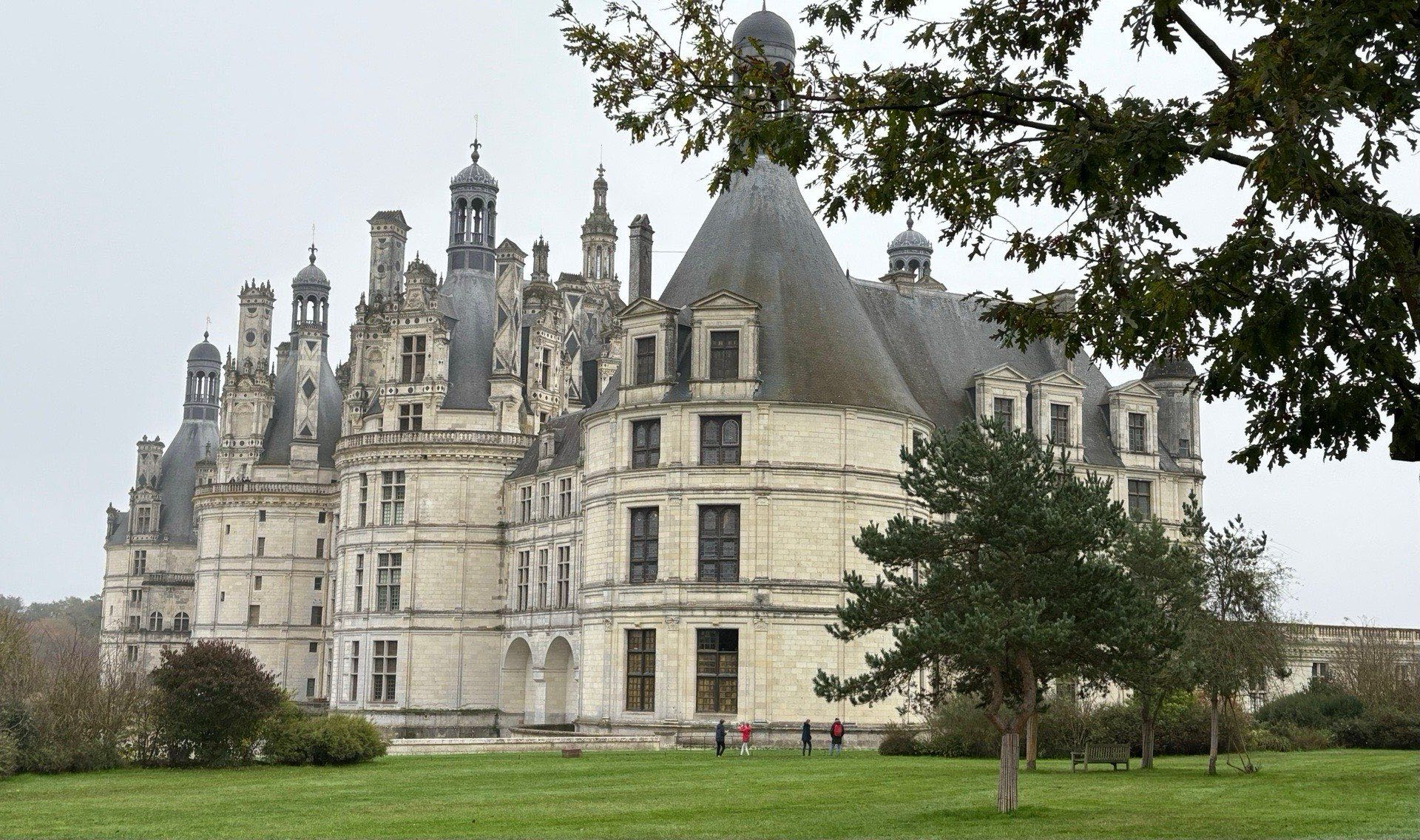
Our first stop: CHATEAU DE CHAMBORD. Originally built by King Francis I as a hunting lodge beginning 1519, this castle has a sad history because, unfortunately, it was mostly uninhabitable! First, it was extremely hard to heat in the cold, damp winters (even though entire trees could be burned in its numerous massive fireplaces). Second, the hot summers brought notorious invasions of pesky mosquitoes, and who would enjoy that?! Third, the thick dense forests surrounding the chateau made hunting even small game difficult—not exactly the best conditions for large hunting parties. The long (or rather short) shot of it was that the chateau was never completely finished and only lived in full time for about 40 years (during the 18th century by close political associates of Kings Louis XV and XVI).
The sparsely furnished rooms we saw here also reflected the fact that much of the furniture used at the chateau during its earlier days was hauled in and out each time it was used, a time consuming and difficult task, adding to its undesirability as a long term residence.
That being said, Chateau de Chambord is a spectacular specimen of Renaissance architecture, featuring a double helix spiral staircase (possibly, but not probably, designed by Leonardo da Vinci) in the very center which connects four massive halls in a Greek-cross pattern on each of three levels. Four square sets of living quarters filled in around the cross on each floor.
Da Vinci did, however, visit this chateau, bringing the famed Mona Lisa painting with him on one occasion. In fact, a copy by a student of Da Vinci hangs here on the third floor (unfortunately, we didn’t have time to find it).

Other notable features include the geometric design of the gardens common to the Renaissance period (even the trees out front were shaped into long rectangular patterns), and the numerous Floir de Lis emblems carved in the doors, an emblem that originated here in Loire Valley!
Instead of climbing countless stairs on the dizzying double helix spiral marvel, Joe (still fighting a case of bronchitis) opted to sit in a lovely cafe nearby with our tour guide who gladly discussed politics with him.
Our lunch break in BLOIS (pronounced with one quick syllable—blowah) was mostly uneventful, except that John had a shocking experience at the restaurant recommended by our guide. The burgers listed on the menu came on “surprise bread.” We had noticed that a burger being served at a nearby table had dark colored bread. Lo and behold, John’s burger came with this mystery bread, and after consuming a good portion of the burger, he concluded that it must be blueberry. Was he shocked when the waiter told him later that it was colored with squid ink! Ugh! Such a revolting revelation to someone who avoids all manner of seafood, especially exotic things like squid ink!
Back on the bus, we traveled a few kilometers down the road to our next destination—CHATEAU DE CHENONCEAU.
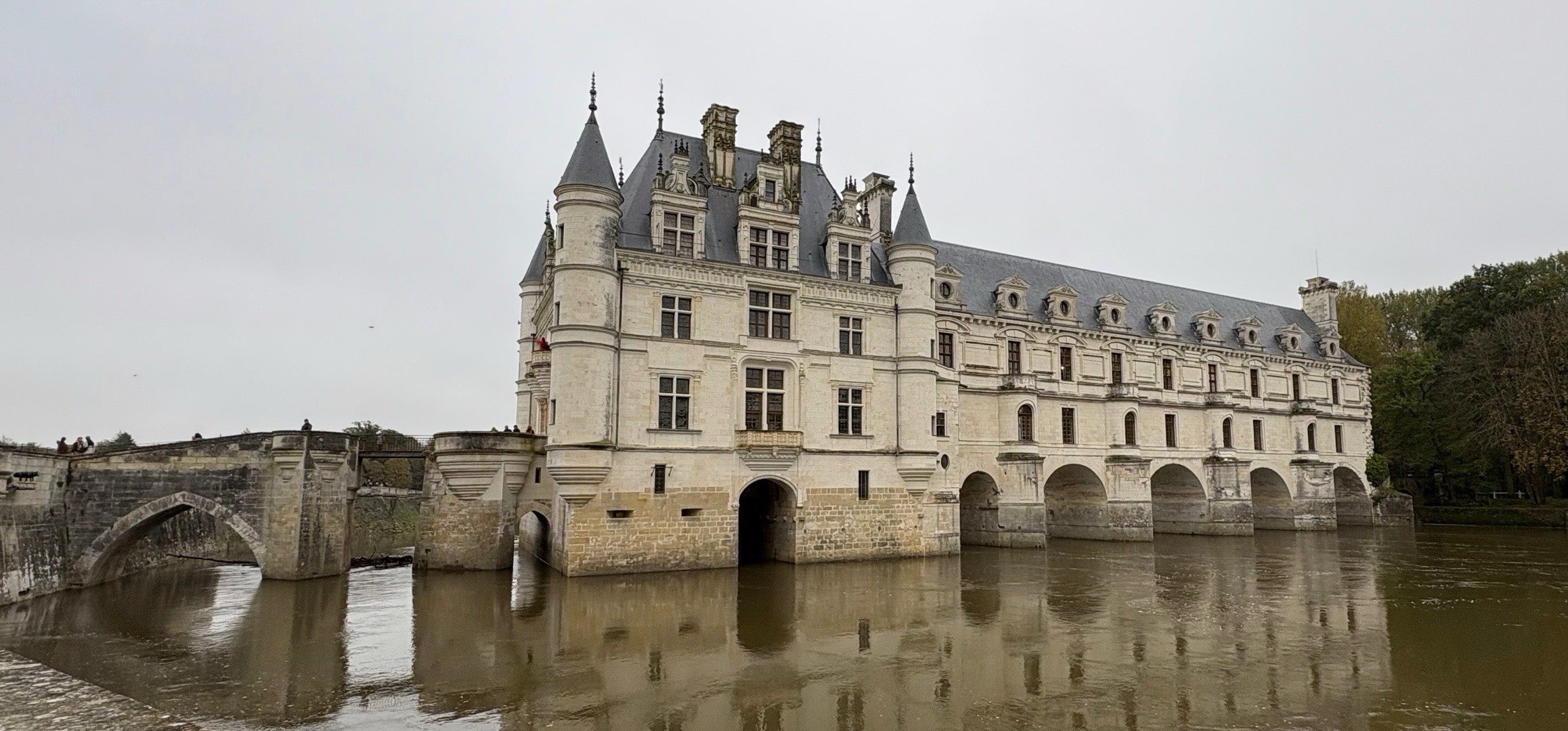
Known as the “Ladies Chateau,” this more intimate and charming castle fittingly became the inspiration for two well known Disney classics, Cinderella and Rapunzel. The designation, Ladies Chateau, is of course grounded in the connection this castle had with various women throughout its history, centered on two in particular: Diane de Poitier and Catherine de Medici, mistress and wife of King Henry II, respectively.
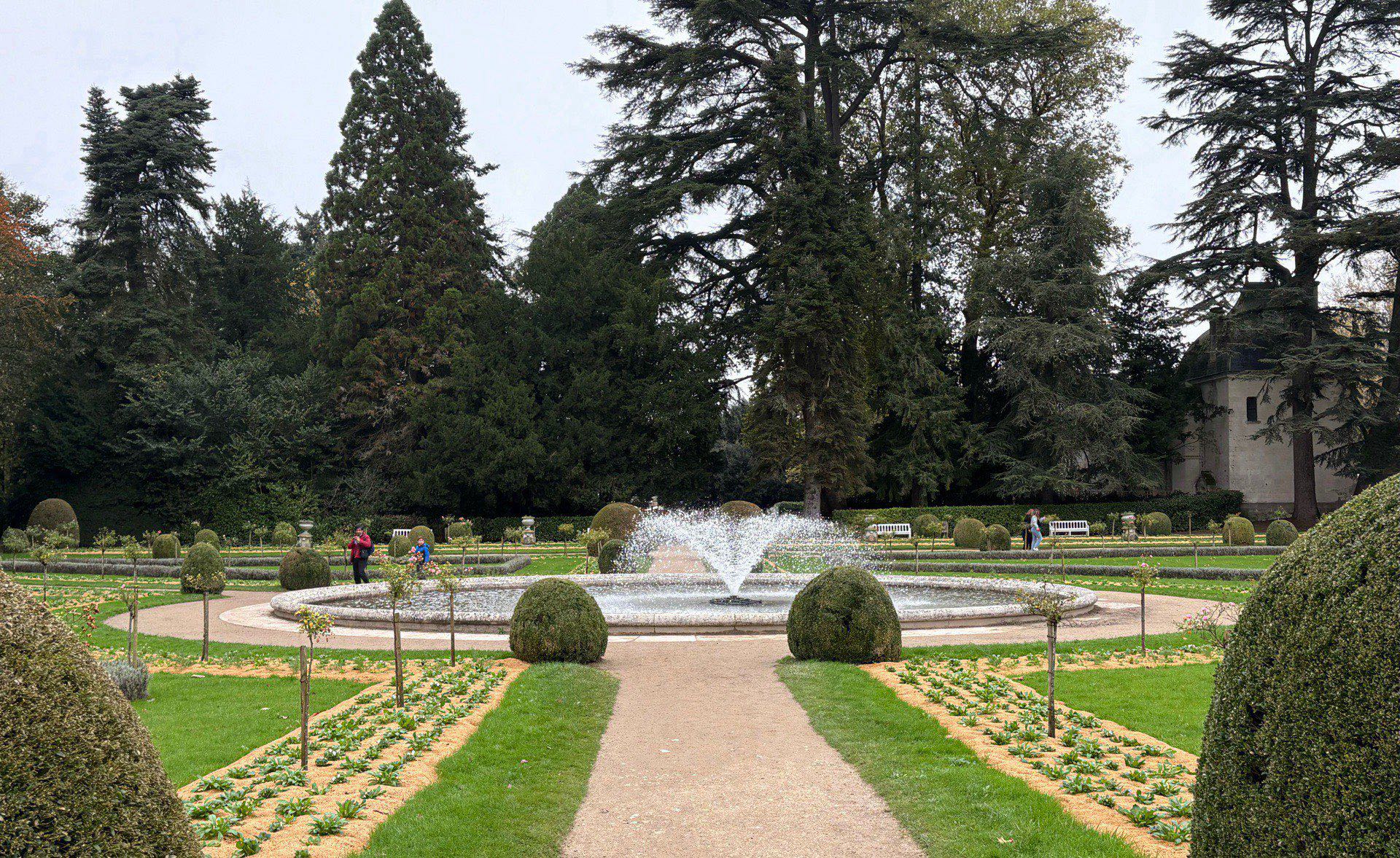
Given first as a gift from Henry in 1547 to Diane (supposedly the most beautiful woman in France at the time), Chateau de Chemonceau was taken over by Catherine after her husband’s untimely death in 1559. Both of these politically powerful women, who also happened to be cousins, put their stamps on this enchanting castle: Diane, by planting a new garden and commissioning the construction of an arched bridge over the River Loire from the back of chateau to the opposite river bank; and Catherine, by constructing a massive two-story gallery across the entire expanse of the bridge (which then served as a grand hall for parties) and by planting another extensive garden.
Being outfitted with lots of ornate furniture, often upholstered to match the wallpaper and heavy drapes, and with numerous period paintings of VIPs, this chateau was instantly more appealing and warm (compared to the previously-toured, cold hunting lodge). Huge fresh flower arrangements, grown directly on the grounds, adorned the massive hallway tables, and we could almost hear the clanging of the shiny copper pots in the kitchen, as servants prepared for an elaborate feast. Yep, this was 16th century chateau living at its finest!

Fun fact—we noticed how short the beds were in these chateaux and our tour guide said that it was NOT because the people were shorter in those days, but because they were superstitious about dying in their sleep in an outstretched position, so they often slept propped up in a semi-reclining fashion and didn’t need the longer beds. Who knew?!
Not so fun fact: Catherine de Medici was also known as the Serpent Queen—for good reasons (which you can google, so I will spare you here).
Later, this chateau would be occupied by several other women of nobility, to eventually become the property of the Menier family, famous for their chocolates, whose descendants still own and maintain it today.
Having had our fill of castles and dragons and fairy tale dreams, we climbed back on the bus for a long trek back to Paris, where we found a bustling café (a very common sight in the evenings) for a quick meal, then ubered (is that a word) our way to the apartment, and fell into bed, ready to say goodbye to Paris and our three-week adventure.


So glad John survived the squid ink🤯🫠❤️
ReplyDelete