Greece: Santorini
Hooray for another slow morning with no alarm clock to force us out of bed…except for the continual call of the buffet.
This morning the seas took it up a notch and the ship rocked and swayed most of the morning. It didn’t prove to be a problem for any of us but Larry and I took a motion sickness pill just in case. The pill made Larry more uncomfortable than the movement from the ship.
Overnight I found it rather pleasant though, it was like a giant cradle and I slept well.
The ship was not able to dock at the port at Santorini and we had to take local boats to tender us to the shore.
We had a tour that was scheduled through our travel agency. All the tours through the cruise line were filled so we had to find our own.
The instructions from our tour company told us to be on the first tender from the ship. We spoke with the excursion people on board, and they told us they cannot guarantee us a spot on the tender if we did not book the excursion through them. We were to show up at the assembly station at 1:00 to get in line for a tender ticket.
We showed up at 12:50 and by 1:00 the line ran as far as we could see. Even arriving that early we were still on the 4th boat. We boarded and were on our 10 minute ferry to Santorini.
This is one of the places I most wanted to visit. I had seen so many pictures of the beautiful white buildings with blue dome roofs, but before arriving I knew very little about it.
The island is actually a caldera; a large volcanic crater. The rim, high above the ocean floor, provides some of the most iconic views in the world. You can take a walk along the rim from Fira to Oia, enjoying panoramic vistas of the Aegean Sea.
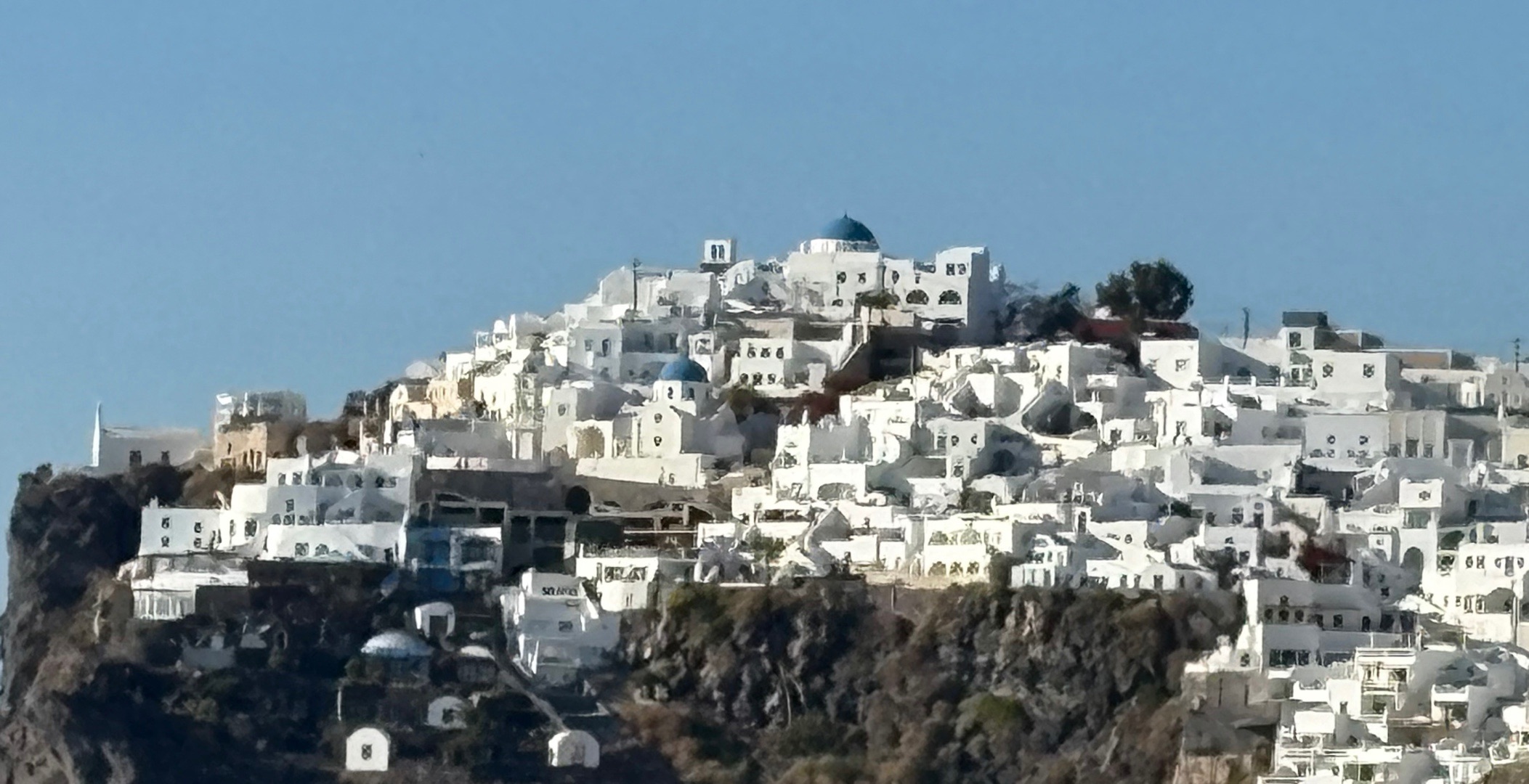
Parts of the rim are missing, and the remnants are in the shape of a crescent moon. From the ship we could see the town perched high along the edge of the rim.
Often referred to as the "Pompeii of the Aegean," this prehistoric city was buried by volcanic ash around 1600 BC. The well-preserved ruins offer a fascinating glimpse into ancient Minoan civilization.
The capital of Santorini is Fira, the first town we saw perched on the edge of the caldera. From the top, it offers stunning views of the sea. The town is filled with charming shops, cafes, and historic buildings.
Santorini is also known for its unique beaches, including Red Beach, White Beach, and Perivolos. The volcanic soil gives the sand its distinctive colors.
There are three primary natural colors on the island, black, red and white, all colors of sentiment resulting from different volcanic eruptions.
Watching the sunset over the caldera is a must-do experience. Oia, the town perched on the farthest north point of the rim, is particularly famous for its sunset views. Many visitors gather to witness the spectacle.
Santorini is known for its wine, particularly Assyrtiko. Grape vines are one of the only plants that grow well on the island as it is too dry for most vegetation to survive. Many wineries offer tours and tastings, allowing you to sample the local product.
We found out that the ships don’t dock at the pier because there are no piers. The rim appears to rise straight up out of the ocean and there is very little space along the ocean’s edge. What little space there is has been filled with souvenir shops.
From the bottom there are only three ways to get to the top:
Walk the 600 steps to the top.
Ride a donkey up the same steps.
Or pay 6€ for a cable car ride.
We chose the latter.
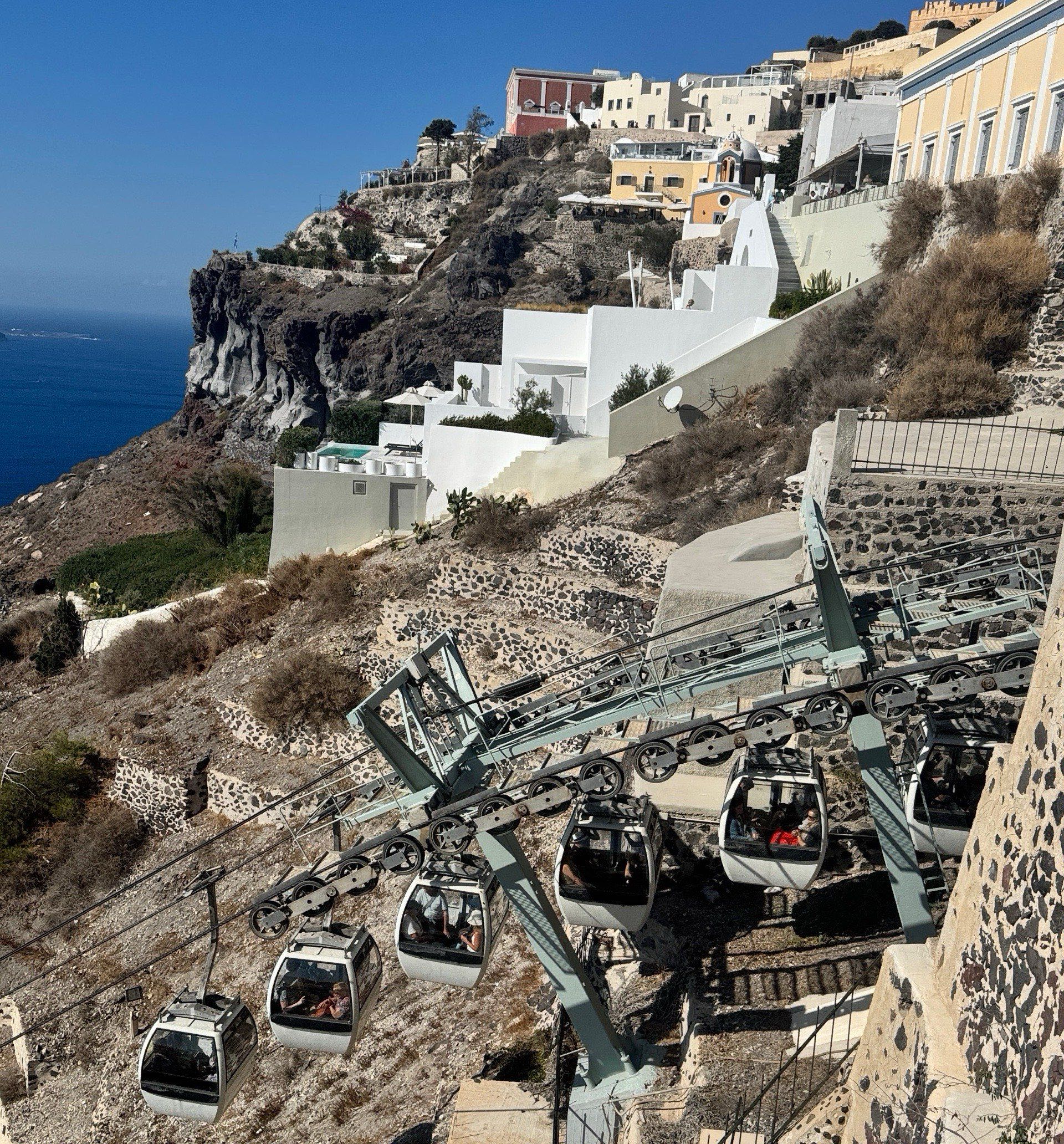
We reached the top in plenty of time for the tour and had time for a drink and our first views of this special place. The infamous white buildings and blue trim reached as far as we could see.
The whitewashed buildings of Santorini are iconic and practical. The tradition dates back centuries and serves several purposes.
The white color reflects sunlight, helping to keep the interiors cool in the hot Mediterranean climate.
The white and blue colors are deeply imbedded in Greek culture and identity. The blue domes and accents symbolize the colors of the Greek flag.
The history of their colors date back almost 100 years. At that time the homes, being made of volcanic rock, were various colors, but predominantly black. During the 1930s the Greek government mandated the whitewashing of homes to prevent the spread of diseases such as cholera. Lime, which was used for the whitewash, has disinfectant properties.
Our tour started at 3:00. Our tour guide Lilly met us at the cable car station at the top. She was one fiery young local lady that was large in expression and exuberance. She was exciting and fun to be with.
Our first stop was at the far southern end of the island at a monastery dedicated to the prophet Elias. The mountaintop offered amazing views of the island and surrounding islands. The monastery made money from their vineyards, among other things.
Lilly told us that Santorini suffered from a lack of water. The reason anything would grow was because the soil was made up of volcanic pumice which holds in moisture.
In the 1960s they opened a water desalination plant which has supplied water to the island’s 22,000 population ever since.
Our tour took us to a black sand beach where we were allowed to take some of the pumice stones.
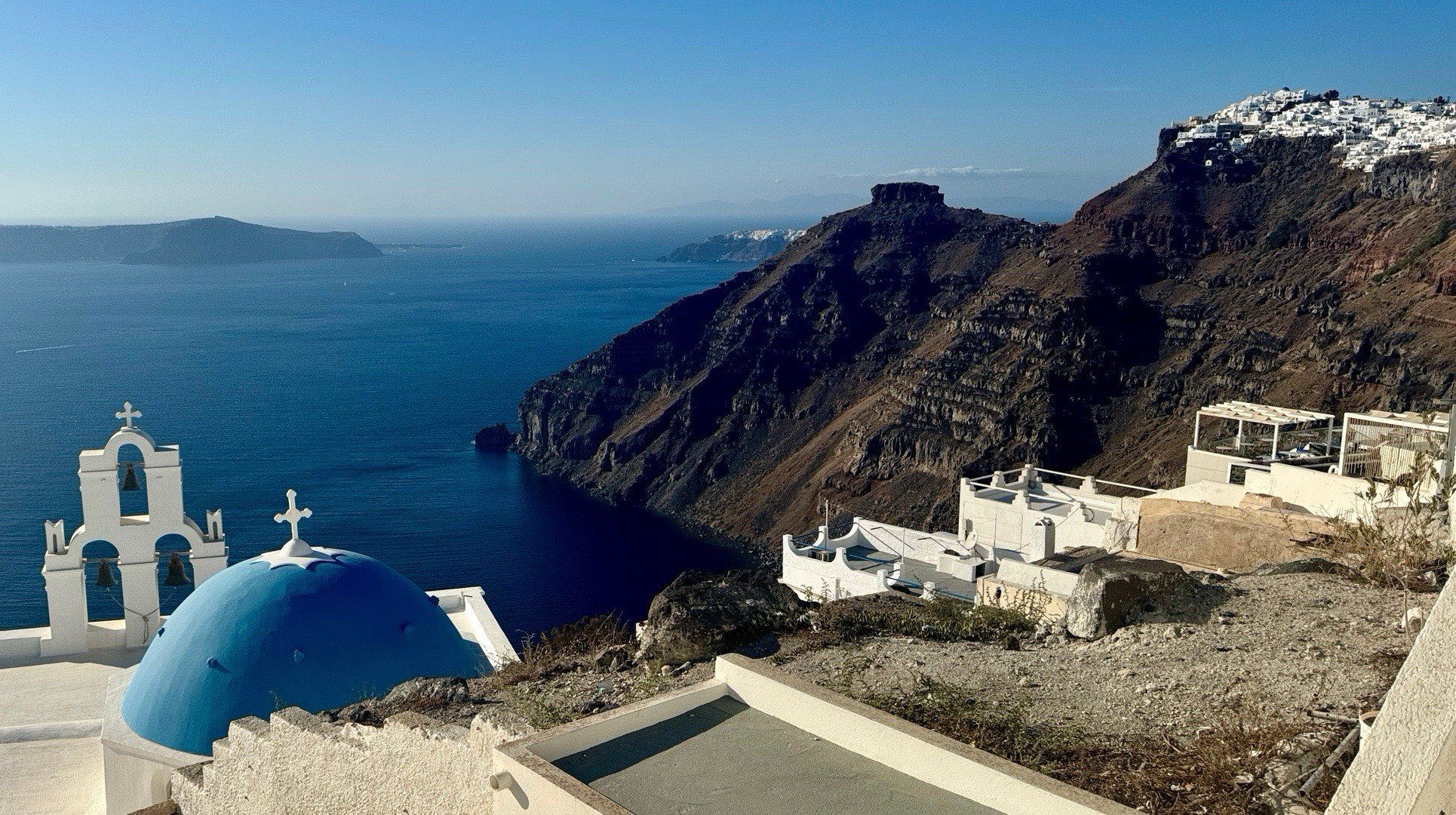
We stopped at another lookout next to one of the most famous blue domes which is seen in many pictures.
It turns out that there are actually very few blue domes on the island.
The iconic scenes that we constantly see with the blue domes are only one of a handful of blue domes across the island.
Only churches are allowed to have the blue domes. People can trim their homes in that same blue color, and homes can have domes, but only a church can have the combination.
Our tour ended at the northern town of Oia. This town is most famous for watching sunsets. Fortunately, we were there at sunset and were able to witness its grandeur.
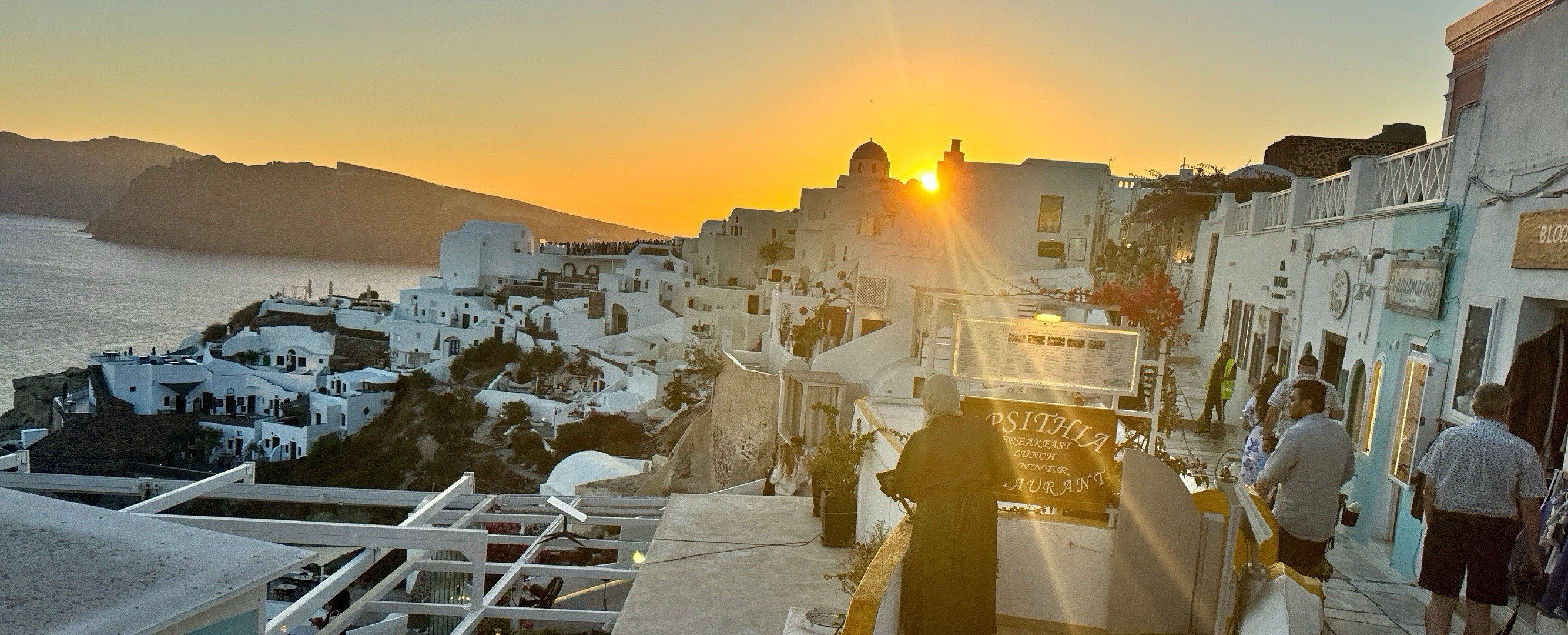
While waiting for the sun to set, we stopped at the local restaurant for a snack. Just below us, along the hillside, were some of the many hotels in the area with rooms averaging $3000 per night, and some up to $10,000 per night.
We watched the sunset behind one more iconic church with its large blue dome, and then boarded the bus back to Fira and to an unbelievably long line to ride the cable car back down to re-board the cruise ship waiting below.
For the first time this trip, the temperature was hot. By the time we boarded the ship, we were all completely exhausted. We went straight to the buffet to eat a little something and then went right to our cabins and collapsed from the activities of the day.
It was only about 8:30 PM, but exhaustion had the better of me and I took off my shoes and fell on the bed and slept for three hours before getting back up to prepare for bed. You know you’re either exhausted or unconscious if you’re on a cruise ship and choose sleep over another buffet.


❤️
ReplyDeleteSo beautiful,I'm thrilled you like blogging and your anointed 🦜💃
ReplyDelete